.png)
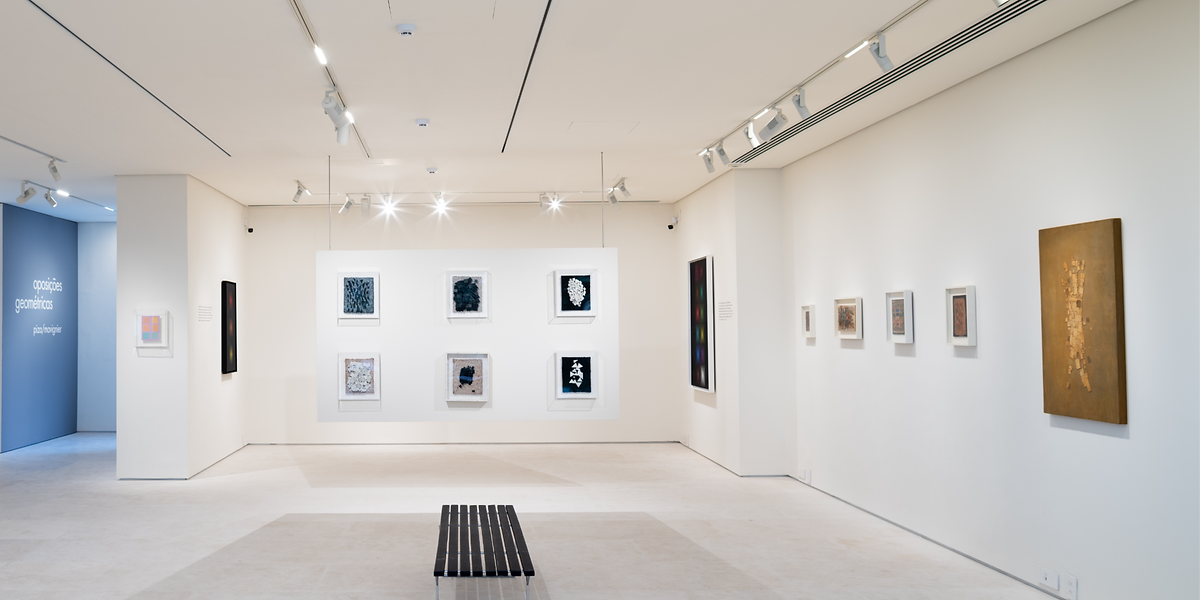
Geometric Oppositions
It is possible to establish a parallel between the works of Almir Mavignier and Arthur Luiz Piza, suggesting evident affinities when both take geometry as a field of investigation, yet this apparent similarity points toward a profound contrast. We chose not to seek a common territory, but rather to intensify the differences between the two artists, whose foundations are almost antagonistic. The exhibition emerges from friction, not convergence. At the end of the journey, what is revealed is not a harmonious dialogue, but the power of dissension. In Piza, geometry manifests itself as gesture, matter, and controlled deviations; in Mavignier, as calculation, system, and optical precision. Between asymmetry and symmetry, between accident and control, the exhibition proposes an exercise in attention that recognizes geometry not as a single language, but as a plural territory.
— Anita Kuczynski
Arthur Luiz Piza and Almir Mavignier: two parallel trajectories, two destinies of Brazilian artists in Europe, two artistic lives that were, in a sense, entirely European. One in Paris, the other in Germany — and therein lies a first and fundamental difference between them. The Paris of the late 1950s was witnessing the decline of its role as the European and global artistic center it had been from the second half of the nineteenth century until shortly before the Second World War. Postwar Germany, meanwhile, seeking to recover its cultural and artistic history interrupted by Nazism, regained a renewed and plural vitality; the age of the avant-gardes belonged to Paris’s past, while in Germany it was being reborn. Mavignier’s active participation in the European avant-garde distinguishes him from the more isolated and discreet position of Piza, whose artistic environment was largely restricted to Paris and the circle of Brazilian and Latin American artists living there in the 1960s — among the last to absorb the impulses of modernity: Lygia Clark, Sergio Camargo, Sérvulo Esmeraldo, and Julio Le Parc. Yet Piza was by no means detached from the European artistic circuit; he exhibited in important galleries and participated in Documenta II in 1959, the Paris Biennale in 1963, and the Venice Biennale in 1966. Mavignier, on the other hand, after a brief stay in Paris, became associated with avant-garde tendencies seeking a new pan-European artistic connection across Germany, Italy, and France.
Piza’s work, intimate and discreet, demanded throughout its more than forty-year trajectory a kind of attention opposite to the demands that today’s visual processes impose upon everyone without exception. Modern poetics — which is Piza’s poetics — requires a conviction that is not abandoned from one moment to the next, and which serves as the singular principle behind his engravings, collages, and reliefs, explored systematically and inexhaustibly.
The dynamics of engraving and collage — techniques that in Piza are virtually reversible — stem from the same origin: the grouping and separation of the first particles. This initial emergence resembles the awakening of matter from immobility, the moment when an autonomous unit confronts the indistinct uniformity of the plane and a nascent relief appears. A self emerges. Free, mobile, uncertain, establishing the opposition between the static whole and this dynamic unit. This issue brings him closer to kinetic art and therefore to Mavignier, but historically as well as procedurally, a distinction must be made: movement in Piza’s work is slow, gradual, cumulative; it unfolds in time, not in space, whereas Mavignier’s process aligns itself with new image technologies and their optical calculations. In Piza, at first, the plane is indistinguishable from matter. In the early collages, plane and matter are confused with one another. It is not an absolutely abstract plane, nor does it evoke just any materiality, but rather a primordial one — that which relates to matter as the plane relates to abstraction. Arid, dry, hard, an undefined crust of land still sterile and prior to life. Thus, the first movement fracturing the plane is not abstract in nature, but organic. This primordial movement begins with a craquelure: minimal fissures and cracks that seem to emerge from a fossilized, slow, almost inert time — the discreet eruption of the surface. The first slow and difficult rupture of matter’s cohesion. At the same time that this fissure establishes a break with the plane, it also defines the dimension and primal behavior of the particles — none of which escapes a primitive, gregarious, collective behavior. The moment of individuation is still far away: each particle remains part of the totality that gives cohesion and structure to the work. There is no wandering or autonomy. Planar tension still dominates individualities and their natural, harmonious movement. Initially, not even color distinguishes them: the same earthy tones of the plane prevail.
The visual impregnation in Piza’s works is slower and denser, more introverted than extroverted, more about depth than surface, resulting from a tension between the purely optical effect characteristic of Mavignier and the slowness of pictorial absorption. Yet in both Piza and Mavignier, the same inquiry into the persistence and possibilities of a strictly visual rationality takes place. More than a century after its emergence, geometric construction continues in both artists in divergent yet correlated ways.
In the end, the correspondences between Piza and Mavignier, throughout an entire lifetime in Europe, converge and offer different responses to this historical moment of artistic transition in Europe — a moment to which both their works and their lives inevitably belonged and contributed.
— Paulo Venancio Filho